

We didn’t start this project because we needed more monitor mixes.
We already had 11 independent IEM mixes running from our Yamaha TF-RACK.
The problem was that they were all mono.
And technically, they worked.
Everyone could hear what they needed. Everyone had their own mix. The system had been reliable.
But as our band got more comfortable with in-ear monitoring, we started hearing the same request more and more:
Can we go stereo?
At first, that might sound like a luxury.
Once we actually made the change, it became pretty obvious that it wasn’t.
Mono worked. Stereo changed the experience.
With a mono IEM mix, everything is essentially competing for the same space.
Vocals.
Guitars.
Keys.
Tracks.
Click.
Drums.
Bass.
Everything is stacked together in the center of your head.
You can change levels and EQ, but spatially, everything still lives in basically the same place.
That can make a busy worship mix feel dense and crowded, especially when a musician needs a lot of sources in their ears.
Stereo gave us another tool:
space.
Instead of solving every problem with volume, we could start solving some of them with placement.
Keys could spread naturally across the stereo field.
Tracks could retain their stereo image.
Guitars could sit slightly left or right.
Background vocals could be positioned away from the lead vocal.
Click and guide could have their own place.
A musician’s own instrument could stay prominent without every other source having to sit directly underneath it.
The result was a monitor mix that felt wider, clearer, and much less congested.
And our ears noticed the difference
One of the biggest benefits wasn’t simply that stereo sounded better.
It was that the mixes became easier to listen to.
When everything is fighting for the center of a mono mix, the instinct is often to keep turning things up just to distinguish one source from another.
Stereo separation gives you another way to create definition.
That doesn’t automatically make an IEM mix safer—volume still matters—but it can make it easier to build a clear, comfortable mix without relying entirely on level to make things audible.
For our band, moving from mono to stereo was a significant improvement.
Once they experienced it, going back to mono wasn’t really something anyone wanted to do.
Which created the next problem.
Eleven people. Eleven stereo mixes.
Moving from mono to stereo effectively doubled the output requirement.
Eleven mono mixes require:
11 output channels.
Eleven stereo mixes require:
22 output channels.
And suddenly a monitor system that had been handling everybody just fine had a new limitation.
Our Yamaha TF-RACK was still capable of generating 10 stereo monitor mixes, but its 16 local analog outputs could only physically feed eight stereo IEM systems.
And we needed eleven.
So instead of immediately asking:
“What new monitor console should we buy?”
I started asking:
“How far can we push the Yamaha system we already own?”
The answer ended up being:
10 stereo mixes from the Yamaha TF-RACK
1 stereo mix from our FOH Yamaha TF5
16 local outputs from the TF-RACK
6 additional outputs from our Yamaha Tio stage box
8 Shure PSM300 wireless systems
3 Behringer Powerplay P1 wired packs
For a total of:
11 independent stereo IEM mixes.
And we did it without buying another console.
Here’s how the whole thing works.
The system we already had
Our monitor system is built around a few key pieces:
Yamaha TF-RACK — dedicated monitor console
Yamaha TF5 — FOH
Yamaha Tio stage box
Dante network
8 Shure PSM300 wireless IEM systems
3 Behringer Powerplay P1 wired packs
The TF-RACK is still the heart of the monitor system.
In fact, 10 of our 11 stereo mixes are generated from the TF-RACK.
Only the final mix comes from the TF5.
That was important to me because I wanted to keep as much of the band’s monitoring as possible on the dedicated monitor console instead of spreading responsibility across multiple desks.
The first eight: Shure PSM300 wireless systems
The first eight mixes are pretty straightforward.
Our eight Shure PSM300 transmitters are located at FOH, right alongside the TF-RACK.
A stereo IEM mix requires two physical outputs, so the TF-RACK’s 16 local outputs work out perfectly:
IEM 1 → Outputs 1–2
IEM 2 → Outputs 3–4
IEM 3 → Outputs 5–6
IEM 4 → Outputs 7–8
IEM 5 → Outputs 9–10
IEM 6 → Outputs 11–12
IEM 7 → Outputs 13–14
IEM 8 → Outputs 15–16
That’s all 16 local outputs used.
So at that point we had:
8 wireless stereo IEM mixes
But the TF-RACK was still generating two more stereo monitor mixes.
We just didn’t have any local outputs left to get them out of the console.
That’s where Dante and the Tio come in.
IEMs 9 and 10: send them back to the stage
The next two musicians use Behringer Powerplay P1 wired packs.
Since those packs are physically on stage, it actually makes more sense for their audio to come out of an output on stage rather than running additional analog lines from FOH.
So we take stereo mixes 9 and 10 from the TF-RACK and send them over Dante to the Yamaha Tio.
The routing looks like this:
TF-RACK IEM 9
→ Dante
→ Tio outputs 1–2
→ Behringer Powerplay P1
TF-RACK IEM 10
→ Dante
→ Tio outputs 3–4
→ Behringer Powerplay P1
Now we have:
8 wireless stereo mixes
plus
2 wired stereo mixes
all being generated from the TF-RACK.
That’s ten.
The eleventh mix
The TF-RACK gets us to ten stereo mixes, but we still have one musician left.
So the final stereo monitor mix comes from our FOH Yamaha TF5.
That mix also travels across Dante to the Tio:
TF5 IEM 11
→ Dante
→ Tio outputs 5–6
→ Behringer Powerplay P1
And that’s how we get to:
11 independent stereo IEM mixes
The final breakdown
8 Shure PSM300 wireless stereo systems
→ mixed from TF-RACK
→ 16 local TF-RACK outputs
2 Behringer Powerplay P1 wired stereo packs
→ mixed from TF-RACK
→ Dante
→ 4 Tio outputs
1 Behringer Powerplay P1 wired stereo pack
→ mixed from TF5
→ Dante
→ 2 Tio outputs
So overall:
10 mixes from the TF-RACK
1 mix from the TF5
8 wireless
3 hardwired
11 stereo IEM mixes total.
Seeing the whole system
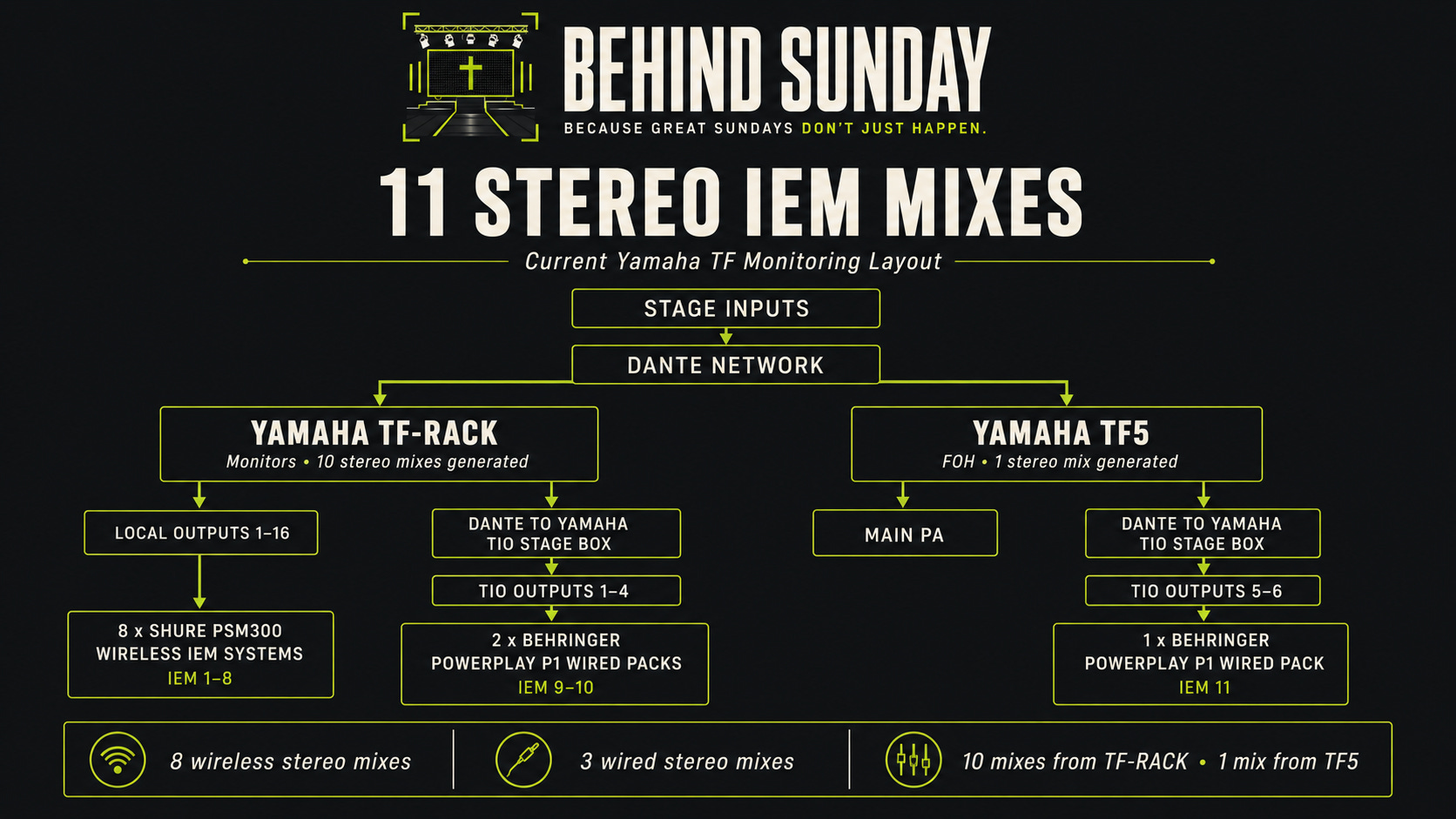
This is where the Dante network really earns its keep.
If I looked only at the back of the TF-RACK, I would see 16 outputs and assume:
Eight stereo mixes. That’s all we’ve got.
But the local outputs aren’t the entire audio system.
The Tio gives us additional analog outputs wherever they’re actually useful.
The TF5 gives us another stereo mix when the TF-RACK reaches its limit.
Once we started looking at the entire Yamaha/Dante system instead of one piece of equipment, the solution became much more obvious.
Why the wired packs actually make sense
The three Behringer P1 packs aren’t just a workaround for not having enough wireless systems.
For musicians who don’t need to move around the stage, wired IEMs can make a lot of sense.
There’s no RF coordination.
No transmitter.
No wireless frequency to manage.
And because the musicians are already near the Tio, the cable run is short and simple.
So the physical layout actually lines up pretty naturally:
People who need mobility → Shure PSM300 wireless
People who can remain hardwired → Behringer P1
That also keeps us from buying wireless systems where we don’t really need them.
Was stereo worth all of this?
For our band?
Absolutely.
The difference wasn’t subtle.
Going stereo didn’t magically make every monitor mix perfect, but it gave us a much better canvas to work with.
Instead of:
everything = center
we now have another dimension available when building the mix.
For example, you might have:
Own vocal → center
Other vocals → slightly spread
Electric guitar → left
Acoustic guitar → right
Keys → stereo
Tracks → stereo
Click → slightly off-center
The exact pan positions aren’t the point.
The point is that not everything has to fight for exactly the same space anymore.
That made the mixes feel more natural and less exhausting.
And once the musicians got used to having that space, the request to stay stereo was pretty unanimous.
One thing stereo doesn’t fix
There is an important caveat here.
Stereo IEMs do not automatically mean safer IEMs.
You can still turn a stereo mix up way too loud.
Hearing protection ultimately comes down to the level reaching the musician’s ears and how long they’re exposed to it.
But stereo can help us create definition without solving every problem by turning another source up.
If I can make something easier to distinguish through placement, I may not need as much level to make it heard.
That’s one of the things our musicians noticed almost immediately.
What I like about this setup
Ten mixes stay on the monitor console
This is probably the biggest win operationally.
Ten out of eleven performers are still controlled from the TF-RACK.
We aren’t really running two separate monitor worlds.
We’re running one primary monitor system with one additional mix borrowed from FOH.
We didn’t replace equipment unnecessarily
We already owned:
the TF-RACK.
the TF5.
the Tio.
the Dante infrastructure.
Instead of buying another console immediately, we figured out how those pieces could work together.
We solved two different limitations differently
There were really two problems.
Problem #1: We ran out of physical outputs on the TF-RACK.
Solution:
Use the Tio.
Then:
Problem #2: We reached the number of stereo mixes we could generate from the TF-RACK.
Solution:
Use one mix from the TF5.
Those are two completely different limitations, and they didn’t require the same solution.
I think that’s an important distinction when troubleshooting any production system.
What I don’t love about it
It works, but there are still compromises.
IEM 11 lives on another console
Ten mixes are on the TF-RACK.
One isn’t.
That means everyone on the production team needs to know:
IEM 11 = TF5.
Otherwise it’s very easy for someone to start adjusting the TF-RACK and wonder why nothing is happening.
The Dante routing is now mission-critical
Those last three IEM packs depend on the Dante routing to the Tio.
So the network patch isn’t just an infrastructure detail anymore.
It’s part of the monitor system.
That means it needs to be documented.
We don’t have much room left
Eleven stereo mixes is a lot for this architecture.
We’ve found a way to make the current system meet the requirement, but I don’t consider this an infinitely expandable solution.
If the band continues growing or our monitoring needs change significantly, eventually the right answer may actually be a different monitor platform.
And that’s okay.
The goal isn’t to avoid upgrades forever.
The goal is to upgrade intentionally instead of buying equipment every time we encounter a problem.
Would I build a brand-new system this way?
Probably not.
If I were designing a monitor system from scratch and knew from day one that we needed eleven or more stereo IEM mixes, I would want one dedicated monitor platform that could comfortably handle all of them with room to grow.
But that wasn’t our situation.
Our question was:
How do we take an existing Yamaha TF system that was already running 11 mono monitor mixes and move the entire band to stereo without replacing everything?
For that problem, I’m really happy with where we landed.
The band got the stereo mixes they were asking for.
The improvement was substantial.
Ten of the mixes still live on our dedicated monitor console.
We used the network and stage box we already owned.
And we didn’t have to make an emergency console purchase just to get there.
Use what you have before buying what you don’t
That’s probably the biggest takeaway from this entire project.
Production people love gear.
I’m certainly not immune to that.
But when we encounter a limitation, I think the first question should be:
What is actually limiting us?
Is it the number of buses?
The number of physical outputs?
The network?
The console?
The workflow?
Or are we simply not using the equipment we already have to its full potential?
In our case, moving from mono to stereo looked like it was going to create a much larger equipment problem.
Instead, it forced us to understand our existing system better.
And that system had more to give than we initially thought.
That’s a pretty good outcome.
If you’re trying to move your church from mono to stereo IEMs—or you’re simply running out of monitor mixes—drop your console, number of musicians, and current IEM setup in the comments.
I’d love to hear how you’re approaching it.
Carlos Sanchez
Behind Sunday
Behind the work. Elevating the mission.